
Paro Festival Tour Bhutan – 8 Days Paro Tsechu, Thimphu & Punakha Cultural Package
Tour Includes
Tour includes the services of 's Tour Manager.
Tour Highlights
Request a Callback
We‘ll reach you within minutes
🔒 Your number is never shared with third parties
Itinerary (Day Wise)
Viewing itinerary for 8 days of Paro.
Day 1
Arrive in Paro, Bhutan – Airport Welcome, Tachog Lhakhang Iron Bridge, Memorial Chorten & Thimphu
Arrive at Paro International Airport (PBH) at 2,280m, where the flight into Bhutan delivers one of the most breathtaking aerial approaches on earth – the Himalayan range unfolds dramatically through the aircraft window as the plane descends into the narrow Paro Valley, with the iconic silhouette of Rinpung Dzong rising above the Pa Chhu river marking the very first impression of the kingdom.Complete immigration and customs formalities before receiving a warm traditional welcome from your local guide, then begin the scenic one-hour drive eastward toward Thimphu through pine-covered valley roads where whitewashed farmhouses, fluttering prayer flags, and the unhurried pace of Bhutanese life line every kilometre of the route.Stop en route at the sacred Tachog Lhakhang (Tachogang Lhakhang), a revered 14th-century temple reached by crossing the Pa Chhu on a traditional iron chain bridge – a masterpiece attributed to the legendary Bhutanese saint and bridge-builder Thangtong Gyalpo, who is credited with constructing 108 such iron bridges across Bhutan and Tibet.Learn how the original structure was washed away by floods in 1969 and faithfully restored in 2005, preserving one of the most significant examples of medieval Himalayan sacred engineering and monastic architecture in the kingdom.Arrive in Thimphu and visit the National Memorial Chorten in the afternoon, a beautifully ornamented stupa built in 1974 in memory of Bhutan's beloved Third King, His Majesty Jigme Dorji Wangchuck – where devoted locals circle in continuous morning and evening prayer in a deeply moving and timeless spiritual ritual.Explore the Centenary Farmers Market nearby, where seasonal produce, local snacks, hand-woven textiles, and the easy conversational rhythm of everyday Bhutanese life create a colourful and authentic first evening in the capital.Check in to the Thimphu hotel and settle in for a well-rested first night in Bhutan's capital city, in preparation for a full day of exploration tomorrow. Overnight Thimphu.
Day 2
Thimphu Full Day – Buddha Dordenma, Takin Preserve, National Textile Museum & Tashichho Dzong
Begin the day with a drive to Kuensel Phodrang to visit the iconic Buddha Dordenma statue, one of the largest bronze Buddha statues in the world at 51.5 metres, gazing serenely over the entire Thimphu Valley from its hilltop position and sheltering over 125,000 smaller gold and silver Buddha statues within its vast interior.For those feeling active, an optional two-hour scenic hike from Buddha Point through the forested ridge trail to Changangkha Lhakhang can be arranged, offering stunning panoramic views across the Thimphu Valley and a rewarding, uncrowded perspective of the capital far from its more visited monuments.Visit the Motithang Takin Preserve, home to the takin – Bhutan's wonderfully unique national animal, a creature so unusual in appearance that local legend attributes its creation to a 15th-century divine madman saint through an act of spiritual alchemy.Explore the National Textile Museum, where the extraordinary craftsmanship of Bhutanese weaving traditions is displayed through rare fabrics, looms, and historical textiles that represent one of the most sophisticated and living artisan cultures in the Himalayan world.Visit the Folk Heritage Museum nearby for an immersive encounter with traditional Bhutanese rural life – a faithfully reconstructed three-storey rammed-earth farmhouse revealing the domestic customs, tools, agricultural practices, and daily rhythms of Bhutan's highland communities across the centuries.In the evening, visit the magnificent Tashichho Dzong beside the Wang Chhu River – the official seat of Bhutan's government and the summer residence of the Je Khenpo (Chief Abbot), its grand whitewashed walls, gilded rooftops, and intricately carved woodwork standing with quiet authority as the administrative and ceremonial heart of the kingdom.Conclude with a relaxed evening stroll through Thimphu town, absorbing the local café culture, artisan shops, and the gentle urban rhythm of Bhutan's capital before retiring for the night. Overnight Thimphu.
Day 3
Thimphu to Punakha via Dochula Pass (3,050m) – 108 Chortens, Chimi Lhakhang & Wangdue Phodrang Dzong
Depart Thimphu after breakfast and begin the scenic climb toward Dochula Pass at 3,050m, one of Bhutan's most iconic high-altitude viewpoints and a defining landmark on any cultural tour itinerary through the kingdom.Arrive at the pass to find the 108 Druk Wangyal Chortens standing in neat, atmospheric rows – a memorial commissioned by Her Majesty the Queen Mother – and on clear days a sweeping panorama of the Eastern Himalayan range stretching endlessly toward the Tibet border, including Bhutan's highest peak Gangkar Puensum at 7,497m.For those seeking an additional highland experience, an optional Lungchutse Hike begins just above the chortens, ascending through rhododendron forest to Lungchutse Temple on a ridge at approximately 3,600m – a rewarding 5–6 km round-trip walk of 3–4 hours with outstanding Himalayan views.Continue the descent along winding mountain roads into the warm subtropical Wangduephodrang Valley, pausing at the historically significant Wangdue Phodrang Dzong, a fortress monastery perched dramatically on a ridge above the confluence of the Punatsang Chhu and Dang Chhu rivers.Take a pleasant 30-minute walk through golden rice paddies and farmland to reach Chimi Lhakhang, the charming hilltop fertility temple in the Lobesa Valley dedicated to the revered 15th-century saint Lama Drukpa Kuenley – the 'Divine Madman' – one of Bhutan's most beloved pilgrimage sites for couples seeking blessings.Arrive in Punakha by evening, checking in to the hotel and settling into the warmth and greenery of Bhutan's former royal capital – one of the most historically significant and naturally beautiful valley regions in the entire kingdom. Overnight Punakha.
Day 4
Punakha – Khamsum Yulley Namgyal Chorten Hike, Punakha Dzong & Suspension Bridge
Begin the morning with a scenic one-hour hike through golden rice paddies and quiet pine forest to reach Khamsum Yulley Namgyal Chorten, a remarkable four-storey temple standing majestically on a ridge above the Punakha Valley with sweeping panoramic views of the terraced fields, river plains, and surrounding mountain ranges.Built over nine years by skilled Bhutanese artisans using traditional methods guided entirely by sacred Buddhist scriptures, this impressive temple was commissioned by Her Majesty the Queen Mother and dedicated to the peace, stability, and well-being of the kingdom and all sentient beings.Explore the richly decorated interior with its traditional thangkas, murals, and religious iconography before descending back to the valley, the full sweep of the Punakha landscape unfolding in every direction from the ridgeline.In the afternoon, visit the magnificent Punakha Dzong, beautifully positioned at the sacred confluence of the Pho Chhu (Father River) and Mo Chhu (Mother River) – widely regarded as the most beautiful dzong in Bhutan, serving as the country's capital until 1955, and the historic site of the first royal coronation of the Wangchuck dynasty in 1907.Explore the richly decorated courtyards, painted corridors, and historic lhakhangs of Punakha Dzong, where centuries of royal Bhutanese heritage are layered into every stone, woodcarving, and sacred fresco within the complex.Conclude the day with a walk across the Punakha Suspension Bridge, one of the longest traditional suspension bridges in Bhutan, where prayer flags flutter above the rushing Pho Chhu below and scenic valley views stretch in both directions – a memorable and photogenic close to a full day in Punakha. Overnight Punakha.
Day 5
Punakha to Paro via Simtokha Dzong (1629) – One of Bhutan's Oldest Fortress Monasteries
Depart Punakha after breakfast and begin the scenic drive back westward toward the enchanting Paro Valley, with a significant cultural stop at Simtokha Dzong along the route.Arrive at Simtokha Dzong, standing approximately 5 km south of Thimphu – built in 1629 by the unifier of Bhutan, Zhabdrung Ngawang Namgyal, it is widely regarded as one of the oldest and most historically significant dzongs in the entire kingdom.Explore its remarkable exterior stone bas-reliefs depicting Buddhist saints and deities – an artistic tradition almost unique among Bhutanese dzong architecture – and its interior shrines, thangkas, and monastic halls that carry nearly four centuries of unbroken religious life.Learn how Simtokha Dzong served as the model for all subsequent dzong architecture across Bhutan, making it not only a place of deep spiritual significance but also the founding template of the kingdom's most distinctive and iconic architectural heritage.Continue the scenic mountain drive through familiar highland passes and pine-covered valley roads toward Paro, the landscape carrying a new depth of familiarity and appreciation after five days exploring Bhutan's most celebrated cultural sites.Arrive in Paro Valley by evening, checking in to the hotel with a growing sense of anticipation for the Paro Tsechu Festival that awaits tomorrow – one of the most spectacular and spiritually significant cultural events in the Himalayan Buddhist world. Overnight Paro.
Day 6
Paro Tsechu Festival – Sacred Cham Mask Dances at Rinpung Dzong, Ta Dzong Museum & Kichu Lhakhang
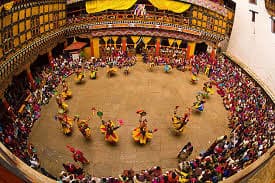
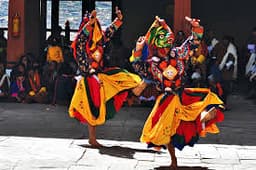
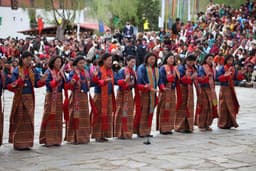
The cultural heart of the entire journey arrives today at the spectacular Paro Tsechu Festival, held annually in the spring at the historic Rinpung Dzong – one of the most vibrant, visually extraordinary, and spiritually significant religious festivals in the entire Bhutanese calendar.Witness the sacred Cham mask dances (chhams) performed by monks and lay dancers in the dzong's main courtyard, each dance a living expression of Vajrayana Buddhist cosmology, representing the subjugation of evil spirits and the triumph of dharma – a tradition believed to bestow blessings and liberation on all who witness it with pure intention.Observe the sea of colour as local Bhutanese families, monks, and officials arrive in their finest traditional attire – the women in elegant kiras and the men in ghos – creating a living tableau of Bhutanese cultural identity at its most vibrant and ceremonial.On the final morning of the festival, if timing aligns, witness the unfurling of the sacred Thongdrel – a massive silk appliqué thangka of Guru Rinpoche revealed at dawn and believed to grant liberation through sight alone – one of the most sacred and emotionally powerful moments in the Bhutanese religious year.In the afternoon, visit Ta Dzong (National Museum of Bhutan), originally constructed in 1646 as a watchtower to protect Rinpung Dzong, now housing a remarkable collection spanning Bhutanese art, armour, textiles, coins, thangkas, and natural history across over a thousand years of the kingdom's cultural heritage.Continue to Kichu Lhakhang (Kyichu Lhakhang), one of the oldest and most sacred temples in Bhutan, believed to have been built in the 7th century by Tibetan Emperor Songtsen Gampo – its atmosphere of deep, unbroken devotion offering a quietly powerful contrast to the festival's vibrant courtyard spectacle.End the evening with a leisurely stroll through Paro town's traditional wooden-fronted shops and artisan stalls, the festival energy still lingering warmly in the mountain air. Overnight Paro.
Day 7
Tiger's Nest Monastery Hike – Paro Taktsang (3,120m) | 4–5 Hours Round Trip
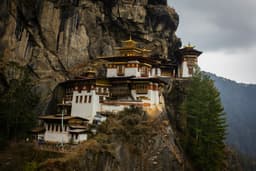
Begin Bhutan's most iconic and universally celebrated hike with an early morning start toward the Taktsang trailhead, where the path immediately enters a world of fragrant blue pine forest, colourful prayer flags, and the distant silhouette of Paro Taktsang clinging impossibly to the sheer granite cliff face 900 metres above the Paro Valley floor.Ascend steadily over 2–3 hours to reach Taktsang Palphug Monastery (Tiger's Nest) at 3,120m – Bhutan's most sacred and globally recognised landmark, where Guru Rinpoche (Padmasambhava) is believed to have arrived on the back of a tigress in the 8th century and meditated in the caves below before establishing Vajrayana Buddhism throughout the kingdom.The Taktsang Cafeteria viewpoint at the halfway mark offers one of the most photographed perspectives in all of Bhutan, where the monastery's white walls and golden rooftops against the vertical cliff face create a defining image of the kingdom – an unforgettable stopping point that rewards even those who choose not to climb further.Continue the final ascent to the monastery complex and explore its interconnected sacred halls, altar rooms, and prayer chambers, each space filled with centuries of unbroken devotion, rare religious murals, and a profound spiritual stillness rooted deep within the mountain granite.Descend over 1.5–2 hours, completing the full round-trip hike in approximately 4–5 hours and returning to the valley with a deep sense of accomplishment and a memory that perfectly caps this eight-day Bhutan festival and cultural experience.Spend the afternoon at leisure – a final, gentle stroll through Paro town's local shops and cafés, perhaps picking up handcrafted Bhutanese souvenirs, incense, or traditional textiles as a last tangible connection to the kingdom before tomorrow's departure. Overnight Paro.
Day 8
Departure from Paro International Airport – End of Paro Festival Tour Bhutan
Wake to a final quiet morning in Paro, where the crisp valley air, soft light on the surrounding pine ridges, and the unhurried Bhutanese rhythm make the prospect of departing feel gently reluctant after eight deeply immersive days of festival, culture, and Himalayan landscape.Enjoy a last breakfast in Bhutan, taking a moment to reflect on the full arc of this extraordinary journey – the Paro Tsechu sacred mask dances, Tiger's Nest at dawn, Punakha Dzong at the river confluence, the 108 chortens above the clouds at Dochula Pass, Simtokha Dzong's ancient stone bas-reliefs, and the warmth of Bhutanese hospitality at every step.Complete final packing and check out, carrying not only carefully chosen Bhutanese souvenirs but a genuine and lasting connection to the living culture, spiritual landscape, and extraordinary people of this remarkable Himalayan kingdom.Transfer to Paro International Airport (PBH) for your onward flight – the same serene and scenic gateway through which this eight-day Paro Festival Tour first began, with Rinpung Dzong watching over the Pa Chhu river one final time in the soft morning light.As the flight lifts off and the festival courtyards, prayer-flag-lined ridges, ancient dzongs, and snow-capped Himalayan peaks of Bhutan slowly dissolve beneath the clouds, allow the colour, devotion, and timeless beauty of the Kingdom of the Thunder Dragon to settle into something permanent and deeply personal.
Know, before you book
Please note: Seats are subject to availability at time of booking.
Airline: On group tours we fly with group-friendly airlines.
Economy class by default.
Upgrades to Business / First Class available on request.
Tour Details
Tour Information
Read this to prepare for your tour in the best way!
- Airfare (Economy class) (optional)
- 3-star and above hotel accommodation (twin sharing)
- Daily breakfast ,Lunch & dinners
- English-speaking Tour Manager throughout
- Government Taxes
- Travel insurance (optional)
- Sightseeing Fees & Visa
Need to Know
- Carry comfortable walking shoes — cobblestone streets ahead!
- Currency: Dollar/ Crypto. ATMs are widely available.
- Weather in June: 18 °C – 25 °C. Light jacket recommended.
- Sustainable Development Fee (SDF) of USD100 per night per adult and USD50 for children aged 5 to 12 years old. Children below 5 years are waived.
- A one-time visa application fee of USD40.
- For Indian: Sustainable Development Fee (SDF) of Rs.1200 per night per adult and Rs.600 for children aged 5 to 12 years old. Children below 5 years are waived and Government of Bhutan will provide on arrival visa.
Cancellation Policy
| Days before departure | Cancellation charge |
|---|---|
| 60+ days | 10% of tour cost |
| 30–59 days | 25% of tour cost |
| 15–29 days | 50% of tour cost |
| 0–14 days | 100% of tour cost |