
Druk Path Trek – 10 Days Paro to Thimphu High-Altitude Trekking in Bhutan
Tour Includes
Tour includes the services of Indruka Tours and Travels's Tour Manager.
Tour Highlights
Request a Callback
We‘ll reach you within minutes
🔒 Your number is never shared with third parties
Itinerary (Day Wise)
Viewing itinerary for 10 days of Paro.
Day 1
Arrive in Paro, Bhutan – Himalayan Mountain Flight, Ta Dzong National Museum & Rinpung Dzong
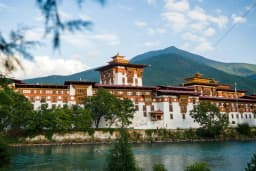
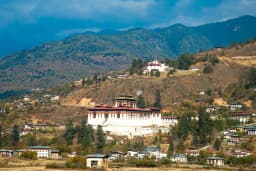
Arrive at Paro International Airport (PBH) on one of the most extraordinary mountain flights in the world – offering aerial views of Mt. Everest, Kangchenjunga, Makalu, and the distinctive Bhutanese peaks of Jumolhari, Jichu Drakey, and Tsrim Gang as the aircraft descends into the narrow, forested Paro Valley.As the runway comes into view, the iconic silhouettes of Paro Dzong and Ta Dzong emerge along the Pa Chu River – a first, unforgettable glimpse of Bhutan's timeless architectural heritage and the valley that will serve as the starting point of your Druk Path Trek.Clear immigration and customs before being warmly welcomed by your Indruka Tours guide and escorted to your hotel in Paro for check-in and rest after the journey.In the afternoon, visit Ta Dzong – the National Museum of Bhutan – originally built as a circular watchtower in the 17th century to defend Paro Dzong against Tibetan invasions, and now home to one of the finest collections of Bhutanese art, artefacts, and natural history specimens in the kingdom, spanning back to the 6th century.Descend to the majestic Rinpung Dzong (Paro Dzong) – 'Fortress on a Heap of Jewels' – still operating as both the religious and administrative headquarters of Paro District, its whitewashed walls, wooden cantilever bridges, and dramatic mountain backdrop making it one of the most photographed landmarks in Bhutan.Spend the evening exploring Paro's charming painted-shopfront main street, picking up any final trekking supplies before an early start tomorrow. Overnight Paro.
Day 2
Tiger's Nest Hike – Paro Taktsang Monastery at 3,120m & Paro Town Exploration
Begin Bhutan's most iconic hike with an early morning start toward Paro Taktsang – the Tiger's Nest Monastery (Taktsang Palphug) – clinging to a sheer granite cliff face at 3,120 meters above the Paro Valley floor, one of the most dramatic sacred sites anywhere in the Himalayan world.The ascent winds through fragrant blue pine forest and winding corridors of colorful prayer flags, with each switchback opening increasingly breathtaking views of the monastery's gilded rooftops set against the sheer rock face – the single most iconic image in Bhutanese travel and a powerful warm-up for the high-altitude days ahead.Rest at the Taktsang Cafeteria viewpoint at the halfway mark – one of the finest photography positions in all of Bhutan – before completing the final ascent to the monastery complex itself, crossing a suspension bridge above a dramatic waterfall-fed gorge.Explore the interconnected temples and meditation caves of the Taktsang complex, where Guru Rinpoche (Padmasambhava) is said to have arrived astride a flying tigress in the 8th century and meditated before establishing Vajrayana Buddhism throughout the Himalayan kingdoms – a site of profound historical and spiritual significance.The full round-trip hike takes approximately 4–5 hours and serves as excellent acclimatization for the Druk Path Trek beginning tomorrow; a horse can be arranged to the halfway cafeteria for those preferring a gentler ascent.Return to Paro in the afternoon for a leisurely town stroll – browsing local handicraft shops, traditional wooden-fronted stores, and Bhutanese cafés – before an early dinner and rest ahead of Day 3. Overnight Paro.
Day 3
Druk Path Trek Begins – Ta Dzong to Jele Dzong Camp | 10 km · 3–4 Hours · 3,450m
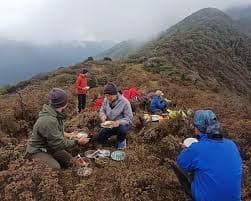
The Druk Path Trek – one of Bhutan's most celebrated and historically significant trekking routes, connecting Paro to Thimphu through a chain of pristine alpine lakes, high-altitude passes, and ancient monastic sites – begins today with an early start to beat the midday heat on exposed uphill sections.The trail departs from above Ta Dzong (National Museum), ascending gradually at first through mixed temperate forest of oak, rhododendron, and blue pine, passing occasional traditional farmhouses where the rhythm of Bhutanese rural life remains entirely unchanged from centuries past.By mid-morning the route enters a dense coniferous belt – one of the best sections of the trail for wildlife and birdwatching, with possibilities of encountering blood pheasants, red pandas, barking deer, and the rustling movements of unseen forest creatures in the undergrowth.The trail climbs steadily through open alpine meadow toward Jelela Pass at approximately 2,600 meters, where views of the Paro Valley begin to open dramatically behind the trekking party.The campsite at Jele Dzong sits in a wide, grassy meadow just below the pass at 3,450 meters – a site traditionally used by yak herders during seasonal upward migration and still carrying the faint traces of centuries of high-altitude pastoral life.Your trekking crew will have camp fully set up on arrival: tents, dining tent, and a hot meal waiting as the temperature drops and the first stars appear above the Himalayan ridgeline. Overnight Jele Dzong Camp (3,450m).
Day 4
Druk Path Trek – Jele Dzong to Tshokham Camp | 10 km · 4–5 Hours · 3,780m
Break camp at Jele Dzong and begin today's stage with a 200-meter climb to the ancient Jeli Dzong structure – a historic royal rest house used during the reign of Bhutan's Second King and now operating as a small monastic institute, its stone walls and butter lamp niches a quiet testament to the route's centuries-long significance.Beyond Jeli Dzong the trail becomes mostly undulating, contouring along high ridges through a landscape of high-temperate forest, open alpine grassland, and scattered boulders draped in grey-green lichen – an environment of extraordinary stillness and natural beauty.The route offers excellent ridge-walk views of the Paro Valley stretching far to the left below, with the town of Paro, Rinpung Dzong, and the Pa Chu River visible on clear mornings – a reminder of how quickly the trek has carried the group into true high-altitude terrain.Tshokham Camp sits at 3,780 meters – a gain of approximately 330 meters from yesterday's camp – in a broad, sheltered meadow surrounded by ancient rhododendron trees whose twisted limbs indicate the altitude and age of this exposed alpine environment.Evenings at Tshokham are among the finest on the Druk Path, with clear nights offering an unobstructed Himalayan sky of extraordinary depth and darkness. Overnight Tshokham Camp (3,780m).
Day 5
Druk Path Trek – Tshokham to Jimi Langtso Lake | 11 km · 5–6 Hours · 3,880m
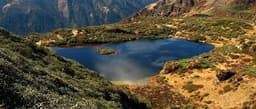
Today is one of the most rewarding stages of the entire Druk Path Trek, culminating at Jimi Langtso – the highest campsite on the route at 3,880 meters and one of the most pristine alpine lakes in Bhutan, its still surface reflecting the surrounding ridgelines and Himalayan sky.The stage begins with a significant 500-meter ascent through increasingly sparse coniferous forest, with rhododendron bushes lining the trail in vivid bursts of pink, crimson, and white when in bloom during spring – one of the most spectacular natural displays on any Bhutan trekking itinerary.As the forest thins above the treeline, the trail passes through open barren hillsides dotted with wild onions, alpine herbs, and scattered boulders, where the air grows noticeably thinner and the silence of the high mountains deepens.After the first high pass, the route becomes mostly undulating – those riding ponies should exercise extra care and dismount on steeper descents where loose shale can make footing uncertain.Before crossing the final pass of the day, the trail follows an extraordinary open ridge where, on clear days, the full arc of the Eastern Himalayan range comes into view: Mt. Kangchenjunga, Chomolhari, Jichu Drakey, and Tsrim Gang rising in a magnificent frozen panorama along the Bhutan–Tibet border.After the final pass, Jimi Langtso Lake appears below to the left, and the trail descends steeply to the lakeside camp where the water is glacially cold and perfectly clear. Overnight Jimi Langtso Camp (3,880m).
Day 6
Druk Path Trek – Jimi Langtso to Simkota Tsho Lake | 11 km · 4–5 Hours · 4,110m
Depart Jimi Langtso in the early morning light, when the lake surface is at its most mirror-like and the surrounding peaks glow with the first warmth of the Himalayan dawn – one of the most photogenic moments of the entire Druk Path experience.The trail traverses through dwarf rhododendron scrub and open high-altitude moorland, bypassing the smaller lake of Janetso nestled in a hollow to the right, before climbing steadily along a wide, undulating ridge toward the upper reaches of the route.This stage offers the highest probability of encountering yak herder camps – semi-permanent shelters of stone and yak-hair felt erected by nomadic Bhutanese pastoralists who bring their herds to these high pastures during the summer months.Spend time at a herder camp if the opportunity arises: sharing butter tea, learning about the traditional transhumance lifestyle that has sustained these communities for centuries, and gaining an understanding of Bhutan's high-altitude pastoral culture that very few visitors ever witness.After crossing one final rocky spur, Simkota Tsho Lake comes into view at 4,110 meters – the highest camp on the Druk Path – its waters a deep, cold blue surrounded by open yak pasture and the raw, elemental landscape of Bhutan's highest trekking country.Arrive at the yak pasture campsite beside Simkota Tsho as the afternoon light shifts across the Himalayan ridges – a location of extraordinary remoteness and natural grandeur. Overnight Simkota Camp (4,110m).
Day 7
Druk Path Trek – Simkota to Phajoding Monastery & Descent to Thimphu | 14 km · 7–8 Hours · 3,870m
Today is the final trekking day of the Druk Path and the longest stage, beginning with a gradual climb from Simkota to a small saddle at 4,150 meters where, on clear mornings, the hulking mass of Gangkar Puensum – the world's highest unclimbed peak at 7,570 meters – and a sweep of adjacent Himalayan summits fill the entire northern horizon.Descend briefly to a small unnamed lake before the final climb to Phume La Pass at 4,220 meters – the highest point on the Druk Path Trek – where a dense forest of colorful prayer flags frames one of the most extraordinary panoramic views in Bhutan: the entire Thimphu Valley laid out far below, the capital city a distant cluster of white buildings in the valley floor.The descent from Phume La drops through ancient juniper woodland – the trees gnarled and wind-shaped by centuries of altitude exposure – passing through the atmospheric grounds of Phajoding Monastery at 3,870 meters, one of Bhutan's most important high-altitude meditation retreat complexes, established in the 13th century and still actively used by monks and hermits in solitary retreat.Trekkers are advised to carry a walking stick through the monastery area where dogs may be present; take time to visit the small temples and meditation huts of the Phajoding complex before continuing the final descent.The trail drops steeply through mixed temperate forest below the monastery, a knee-testing 2-hour descent through pine and fir to the trek endpoint on the outskirts of Thimphu, where vehicles await to transfer the group to their hotel.Bid a heartfelt Tashi Delek farewell to the trekking crew – the cooks, horse handlers, and camp staff who have made five days of wilderness comfort possible in one of the world's most demanding high-altitude environments. Overnight Thimphu.
Day 8
Thimphu Sightseeing – Buddha Dordenma, Changangkha Temple, Tashichho Dzong & Arts & Crafts
Begin the first rest day after the trek with a well-earned leisurely breakfast before embarking on a full day of Thimphu sightseeing – Bhutan's uniquely unhurried capital city and one of the few national capitals in the world without a single traffic light.Visit the National Memorial Chorten, built in 1974 in memory of the beloved Third King Jigme Dorji Wangchuk – where devoted locals gather throughout the day to circumambulate and spin prayer wheels in an expression of living Buddhist faith that has continued unbroken for five decades.Drive to Kuensel Phodrang to visit the colossal Buddha Dordenma statue – 51.5 meters of gilded bronze housing 125,000 smaller Buddha statues within – offering sweeping panoramic views across the entire Thimphu Valley and the forested ridgelines that enclose it.Visit the 15th-century Changangkha Lhakhang, a fortress-like temple on a ridge above the city and one of Thimphu's oldest and most beloved places of worship, followed by the Motithang Takin Preserve – home to the takin, Bhutan's extraordinary national animal, a unique bovid found only in the Eastern Himalayan region.Explore Bhutan's living artistic traditions at the National Institute for Zorig Chusum (School of Arts and Crafts), where students master the Thirteen Traditional Arts including thangka painting, weaving, woodcarving, and lacquerwork – followed by visits to the National Library, Traditional Handmade Paper Factory, and the Goldsmith & Silversmith unit.On the descent through the city, stop at Zilukha Nunnery and Dechenphodrang Monastic School before concluding the day with an evening visit to the magnificent Tashichho Dzong – seat of Bhutan's royal government – its golden rooftops glowing warmly in the fading light. Overnight Thimphu.
Day 9
Thimphu to Paro – Scenic Drive via Chhuzom Confluence & Three-Style Chortens
Enjoy a relaxed free morning in Thimphu – time to browse the weekend market if open, visit any remaining sights, purchase Bhutanese handicrafts as souvenirs, or simply sit at a café and absorb the unhurried rhythm of Bhutan's capital for the last time.After lunch, begin the scenic drive westward from Thimphu toward Paro, following the Wang Chhu River as the road descends through forested gorges and riverside villages toward the valley floor.Reach Chhuzom – the confluence of the Wangchuk and Pa Chu rivers – one of the most geographically and culturally significant road junctions in Bhutan, serving simultaneously as a vehicle checkpoint and immigration point for the western valleys.At the river confluence, observe three distinct styles of chorten standing in close proximity: a Tibetan-style chorten, a classical Bhutanese chorten, and a Nepalese stupa – each architectural tradition represented at this single riverbank crossroads, a quiet reflection of the intersecting cultural currents that have shaped Bhutanese civilization.Cross the bridge at Chhuzom and turn right toward Paro, following the Pa Chu upstream as the valley widens into the familiar landscape of the Paro Valley – the fertile paddy fields, whitewashed farmhouses, and ridge-top monasteries that welcomed you on Day 1.Check in to your Paro hotel for a final night in the valley, with time for a last evening stroll through Paro town before dinner. Overnight Paro.
Day 10
Departure from Paro International Airport – End of Druk Path Trek
Enjoy a final breakfast in Paro, taking a quiet moment to reflect on ten extraordinary days – the soaring approach into the Himalayan valley, the ascent to Tiger's Nest, five days of wild high-altitude trekking through pristine alpine lakes and yak pastures, the sacred solitude of Phajoding Monastery, and the warmth of Bhutanese hospitality that has accompanied every step.Complete final packing and check out of your hotel, carrying the deep physical and spiritual satisfaction of having walked one of the Himalayan world's finest point-to-point treks from Paro to Thimphu – a journey that connects two of Bhutan's most historically significant valleys through some of its most pristine and rarely visited high-altitude wilderness.Transfer to Paro International Airport (PBH) for your onward flight, where your guide bids a final Tashi Delek farewell – departing Bhutan with aching legs, a full heart, and memories of an extraordinary kingdom that has chosen happiness over speed, and meaning over growth.
Know, before you book
Please note: Seats are subject to availability at time of booking.
Airline: On group tours we fly with group-friendly airlines.
Economy class by default.
Upgrades to Business / First Class available on request.
Tour Details
Tour Information
Read this to prepare for your tour in the best way!
- Airfare (Economy class) (optional)
- 3-star and above hotel accommodation (twin sharing)
- Daily breakfast ,Lunch & dinners
- English-speaking Tour Manager throughout
- Government Taxes
- Travel insurance (optional)
- Sightseeing Fees & Visa
Need to Know
- Carry comfortable walking shoes — cobblestone streets ahead!
- Currency: Dollar/ Crypto. ATMs are widely available.
- Weather in June: 18 °C – 25 °C. Light jacket recommended.
- Sustainable Development Fee (SDF) of USD100 per night per adult and USD50 for children aged 5 to 12 years old. Children below 5 years are waived.
- A one-time visa application fee of USD40.
- For Indian: Sustainable Development Fee (SDF) of Rs.1200 per night per adult and Rs.600 for children aged 5 to 12 years old. Children below 5 years are waived and Government of Bhutan will provide on arrival visa.
Cancellation Policy
| Days before departure | Cancellation charge |
|---|---|
| 60+ days | 10% of tour cost |
| 30–59 days | 25% of tour cost |
| 15–29 days | 50% of tour cost |
| 0–14 days | 100% of tour cost |